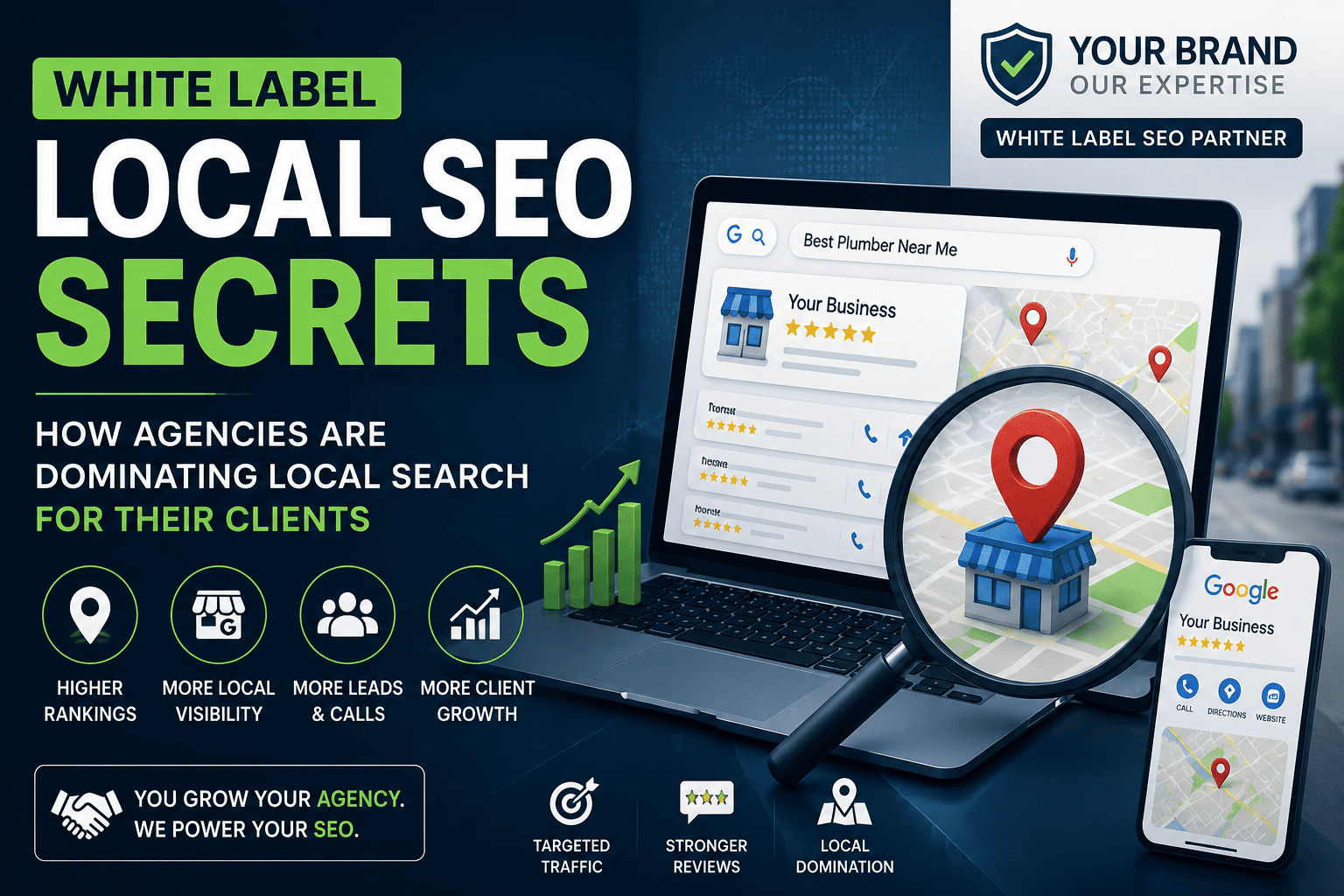
If you run a digital marketing agency, you already know that local clients want rankings, calls, and foot traffic not jargon. That’s exactly why white label seo has quietly become the backbone of how modern agencies scale their local search offerings without hiring an entire in-house team. Instead of building specialized departments from scratch, agencies are partnering with outsourced experts who work invisibly behind the scenes, delivering results under the agency’s own brand name. The result is a business model where small teams can compete with much larger firms, offering full-service local SEO without the overhead of full-service staffing.
This shift isn’t a trend — it’s a structural change in how local search is delivered. Agencies that once struggled to keep up with algorithm updates, citation building, and Google Business Profile optimization are now quietly outsourcing that heavy lifting, rebranding the work, and passing polished results to their clients. Let’s break down exactly how this works, why it’s exploding in popularity, and how to choose the right partner if you’re considering it for your own agency.
What Is White Label SEO and Why Agencies Rely On It
At its core, white label SEO means one company performs the actual SEO work while another company — the agency — sells and presents that work as its own. Clients never know a third party is involved. This arrangement lets agencies offer white label seo services ranging from keyword research to link building, without needing specialists on payroll.
The Core Difference Between In-House and Outsourced SEO
Building an in-house SEO department requires hiring content writers, technical specialists, link builders, and strategists — a significant financial commitment before a single client is even onboarded. A white label seo agency, by contrast, already has that infrastructure in place. Agencies simply plug into an existing team, pay for the deliverables, and focus their own energy on client relationships, sales, and account management. This division of labor is precisely why so many boutique and mid-size agencies have been able to punch above their weight in competitive local markets.
The Rise of White Label Local SEO for Multi-Location Clients
Local search has its own unique set of challenges — inconsistent citations, duplicate Google Business Profiles, review management, and location-specific keyword targeting. This is where white label local seo has become particularly valuable. Agencies managing multi-location clients (think regional dental chains, law firm networks, or franchise restaurants) often can’t justify building a specialized local search team internally, so they lean on outsourced partners who already understand the nuances of local pack rankings, map citations, and geo-targeted content.
Why Multi-Location Campaigns Need Specialized Support
Ranking one business in one city is manageable. Ranking twenty locations across ten cities, each with its own competitive landscape, is a different challenge entirely. Agencies offering white label local seo services typically bring standardized processes for citation audits, review generation workflows, and location-page optimization — systems that would take years to build internally but can be accessed almost immediately through a white label partnership.
Understanding White Label SEO Pricing Models
One of the first questions agencies ask when exploring this model is about cost. White label seo pricing varies significantly depending on the scope of work, the competitiveness of the client’s market, and whether services are billed hourly, per project, or as a flat monthly retainer.
Common Pricing Structures
Most providers structure their offerings around white label seo packages — pre-built tiers that bundle a set number of backlinks, content pieces, technical fixes, and reporting hours into a single monthly price. This makes it easier for agencies to predict margins and communicate value to their own clients, since they can mark up a known cost rather than negotiating custom scopes for every account. Agencies that resell these packages typically aim for a healthy margin while still keeping pricing competitive enough to win local business.
The Role of White Label SEO Copywriting in Local Rankings
Content remains one of the strongest ranking signals for local search, and that’s why white label seo copywriting has become its own specialized niche within the broader outsourcing ecosystem. Location pages, service pages, blog content, and Google Business Profile posts all need to be written with both search intent and local relevance in mind.
Why Local Content Requires a Different Approach
Generic content doesn’t move the needle for local rankings. Copy needs to reference neighborhoods, local landmarks, regional terminology, and community-specific pain points. Agencies that outsource this work rely on writers who understand how to naturally weave geographic modifiers and semantic variations into content without it reading like a keyword-stuffed template. Done well, this content supports both organic rankings and the kind of trust signals that convert visitors into paying customers.
How to Vet a White Label SEO Firm: Reviews, Reddit, and Reputation
Not every provider delivers what they promise, which is why due diligence matters before signing a contract. Reading white label seo firm reviews on independent platforms — rather than relying solely on testimonials published on the provider’s own site — gives a more honest picture of consistency, communication, and actual ranking results.
Where Agencies Go to Compare Notes
Beyond formal review sites, many agency owners turn to community forums to get unfiltered opinions. Searching white label seo reddit threads often surfaces candid discussions about which providers deliver real results versus which ones cut corners on link quality or use outdated citation tactics. These conversations can be more valuable than polished case studies, since they reflect real experiences from people managing their own client accounts.
When agencies ask peers who they’d recommend, the same names tend to come up repeatedly. Compiling a shortlist of the best white label seo agency options in your niche — then requesting sample reports, case studies, and references — is one of the most reliable ways to avoid a costly mismatch.
Why Technical Foundations Still Matter
Content and links get most of the attention, but none of it matters if the underlying website has technical problems blocking crawlability or causing poor user experience. This is why serious providers pair their offerings with genuine technical seo services, addressing issues like site speed, mobile usability, structured data, and crawl errors before layering on content and outreach strategies.
Starting With an Audit
Any responsible partnership should begin with a technical seo audit service to identify existing issues — broken redirects, duplicate content, missing schema markup, or indexing problems — before new work is layered on top of unresolved technical debt. Skipping this step often means content and links underperform simply because the site itself has structural issues holding it back.
Choosing a Partner With Real Technical Depth
Not every provider that claims to offer “SEO” actually has deep technical expertise. Agencies should specifically look for a technical seo agency with a track record of fixing complex issues like Core Web Vitals problems, JavaScript rendering issues, and international or multi-location site architecture — the kind of work that requires genuine engineering knowledge, not just surface-level checklist audits.
The Emerging Role of AI in White Label SEO
Artificial intelligence has started reshaping how outsourced SEO teams operate, from automating keyword clustering to speeding up content drafts and technical audits. White label ai seo providers are increasingly using machine learning tools to analyze SERP patterns, predict content gaps, and generate first-draft content that human editors then refine for tone and accuracy.
Balancing Automation With Human Oversight
While AI can dramatically speed up research and first drafts, local SEO still depends heavily on human judgment — understanding a client’s brand voice, verifying local business details, and making nuanced editorial decisions. The agencies getting the best results are the ones treating AI as an efficiency tool rather than a full replacement for experienced strategists.
Budget Considerations for Agencies Reselling SEO
Beyond simply choosing a pricing tier, agencies need to think carefully about their overall budget strategy when reselling SEO services. Setting margins too thin can make the arrangement unsustainable once account management time and client communication are factored in, while margins set too high can price an agency out of competitive local markets. Many successful agencies start with a mid-tier package, track results closely for the first ninety days, and adjust their retainer structure once they understand true delivery costs and client retention rates.
Choosing the Right Fit: Solo Consultants, Small Agencies, and Enterprise Teams
Not every agency has the same needs, and white label partnerships should be matched accordingly.
Solo Consultants
Independent consultants often benefit most from flexible, project-based arrangements, since their client roster can fluctuate month to month. A pay-as-you-go structure avoids locking them into retainers they can’t yet fill.
Small and Mid-Size Agencies
Agencies with a handful of steady local clients typically do best with tiered monthly packages, since predictable costs make it easier to forecast profit margins across multiple accounts.
Enterprise and Multi-Location Teams
Larger agencies managing dozens of locations for a single client usually need custom scopes, dedicated account managers, and providers experienced specifically in multi-location rollouts rather than one-off local campaigns.
Final Thoughts on Getting Started
Whether you’re a solo consultant taking on your first local client or an established agency scaling to hundreds of accounts, the underlying logic stays the same: outsourcing execution frees you up to focus on strategy, sales, and client relationships. The agencies winning in local search right now aren’t necessarily the ones with the biggest internal teams — they’re the ones who’ve found reliable partners and built repeatable systems around them.
FAQ
Is white label SEO legal and ethical?
Yes. It’s a standard business arrangement in the marketing industry, similar to how many agencies outsource design work, PPC management, or web development while presenting the final product under their own brand.
Will my clients know I’m outsourcing their SEO?
Reputable providers work entirely behind the scenes, using your agency’s branding on reports and communications, so clients only interact with you directly.
How long does it take to see local ranking results?
Most local campaigns show measurable movement within three to six months, though timelines depend on competition level, existing site authority, and how many locations are being targeted.
Can small agencies really compete using outsourced local SEO?
Yes — this is one of the main reasons the model has grown so quickly. Smaller agencies can offer enterprise-level service without enterprise-level overhead by leaning on experienced outsourced teams.
What should I ask a provider before signing a contract?
Ask for sample reports, references from current agency clients, average time-to-results data, and a clear breakdown of exactly what’s included at each pricing tier.