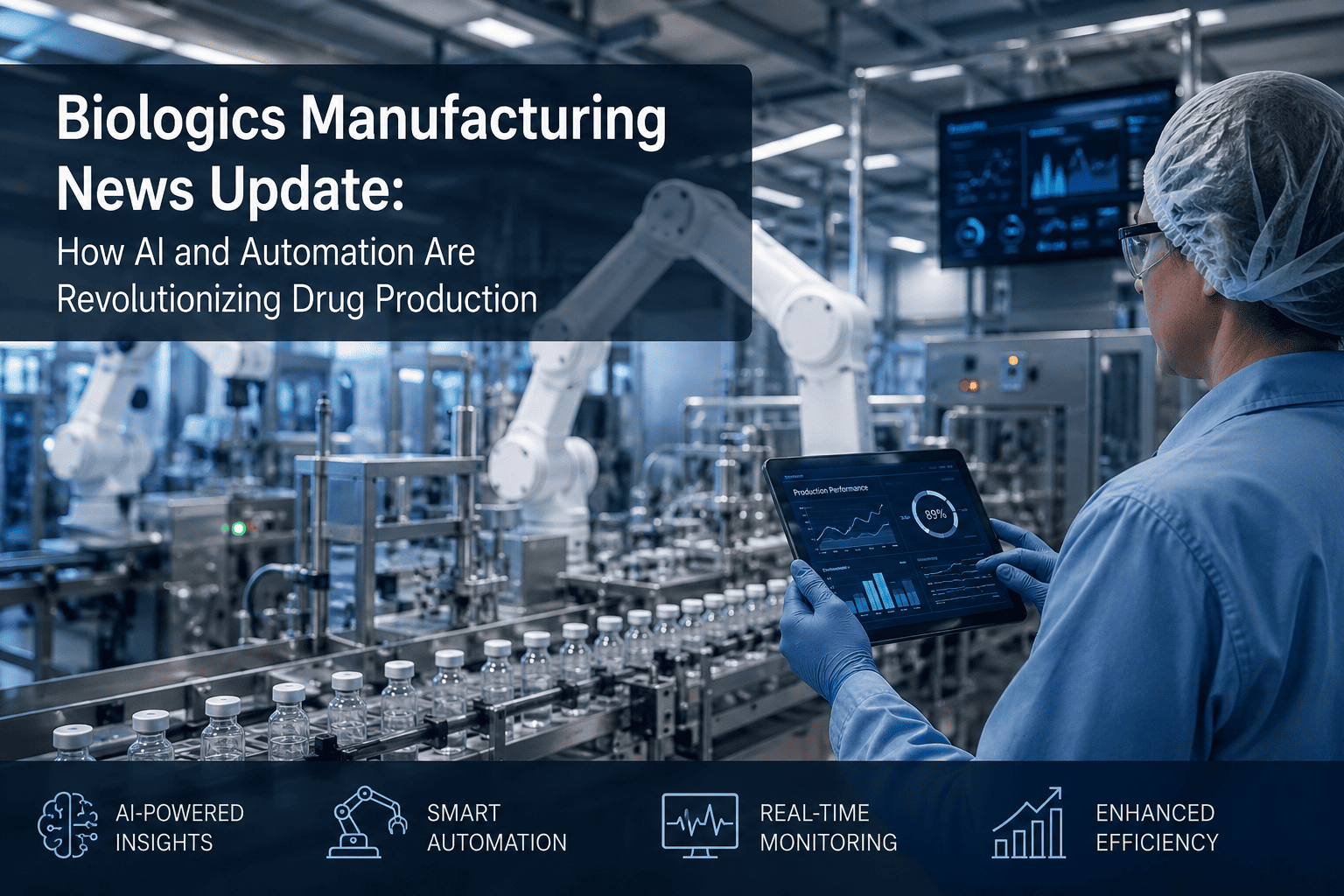
Anyone tracking Biologics Manufacturing News this year has noticed the same pattern repeating across press releases, investor calls, and trade publications: artificial intelligence and automation are no longer experimental add-ons in drug production — they are becoming the backbone of how biologics get made. From continuous bioprocessing lines that self-adjust in real time to machine-learning models that predict batch failures before they happen, the manufacturing floor of a modern biologics facility looks radically different from what it did even five years ago.
For a U.S.-based audience — whether you’re a biotech professional, an investor, a student researching the industry, or simply a patient curious about how your medication is made — understanding this shift matters. Biologics now represent one of the fastest-growing and most expensive categories of medicine in the country, and the way they’re manufactured directly affects drug availability, pricing, and safety. This article breaks down what’s changing, why it matters, and where to look for deeper detail on specific subtopics.
Why Biologics Manufacturing News Matters Right Now
Every week brings fresh Biologics Manufacturing News: a new FDA approval tied to an automated fill-finish line, a biotech announcing an AI-driven quality control system, or a contract manufacturer expanding capacity to meet demand for monoclonal antibodies and cell therapies. This isn’t a niche story anymore — it intersects with public health policy, drug shortages, and the broader Pharma manufacturing news cycle that shapes how the U.S. healthcare system functions.
The reason this coverage has intensified comes down to three converging forces:
- Demand growth — Biologics now account for a large and rising share of new drug approvals, especially in oncology, immunology, and rare disease treatment.
- Manufacturing complexity — Unlike small-molecule drugs made through chemical synthesis, biologics are grown, cultured, and purified from living systems, which makes consistency far harder to achieve at scale.
- Technology maturity — AI, robotics, and sensor-based automation have finally reached a point where they can reliably monitor and adjust these living, sensitive processes without constant human intervention.
If you follow Biotech news today, you’ll see these three threads woven through nearly every major manufacturing announcement.
What Does “Biologics” Actually Mean?
Before diving deeper, it helps to clarify Biologics meaning in plain terms. Biologics are medical products derived from living organisms or cells — rather than being chemically synthesized like traditional pills. They include vaccines, monoclonal antibodies, gene therapies, blood products, and recombinant proteins like insulin.
Are Biologics Made From Human Cells?
A common question among patients and students alike is whether Are biologics made from human cells is actually true. The answer is: sometimes, but not always. Many biologics are produced using mammalian cell lines (such as Chinese Hamster Ovary, or CHO, cells) that have been engineered to produce a specific protein or antibody. Others rely on bacterial systems like E. coli, yeast, or even plant-based expression systems. Human cell lines are used in select cases — particularly for certain gene and cell therapies — but the majority of commercial biologics manufacturing relies on non-human biological systems engineered to mimic human protein structures closely enough to be therapeutically effective.
Biologics vs Biosimilars: Clearing Up the Confusion
Another frequent point of confusion in Biologics Manufacturing News coverage is the distinction between Biologics vs biosimilars. A biologic is the original, brand-name biological product approved through a rigorous clinical trial pathway. A biosimilar is a highly similar version of that original biologic, developed after the original’s patent protections expire — comparable to how a generic drug relates to a small-molecule brand-name medication, though the comparison isn’t perfect because biosimilars can’t be chemically identical to their reference product due to the inherent variability of biological manufacturing.
Biosimilars have become an increasingly important part of the U.S. healthcare cost conversation, since they typically enter the market at a lower price point while undergoing their own regulatory review to demonstrate no clinically meaningful differences from the original biologic.
Inside the Biologics Manufacturing Process
Understanding today’s automation and AI trends requires a basic grasp of the Biologics manufacturing process itself. Unlike traditional pharmaceutical manufacturing, biologics production is closer to industrial-scale biology than industrial chemistry.
Biologics Manufacturing Process Steps
The Biologics manufacturing process steps generally follow this sequence:
- Cell line development — Engineering a cell line to produce the target protein or antibody.
- Cell banking — Creating master and working cell banks to ensure a consistent, traceable source of cells for every future batch.
- Upstream processing — Growing the cells in bioreactors under tightly controlled conditions (temperature, pH, oxygen, nutrients) so they produce the desired biologic.
- Downstream processing — Purifying the product through filtration, chromatography, and other separation techniques to remove cellular debris and impurities.
- Formulation and fill-finish — Combining the purified biologic with stabilizing agents and filling it into vials, syringes, or other delivery devices.
- Quality control and release testing — Verifying potency, purity, and sterility before the batch can be released to market.
Each of these steps has become a target for AI and automation upgrades, which is exactly where the current wave of manufacturing news is concentrated.
How AI and Automation Are Changing Each Stage
Upstream Processing Gets Smarter
Bioreactors today are increasingly equipped with sensors feeding real-time data into machine-learning models that predict cell growth curves and flag deviations long before a human operator would notice a problem. This reduces batch failures — historically one of the most expensive risks in biologics production, since a failed batch can represent millions of dollars in lost material and delayed patient access.
Downstream Purification and Predictive Quality
AI-driven predictive analytics are also reshaping downstream purification. Instead of relying solely on end-of-batch testing, manufacturers are using continuous monitoring to predict purity and yield mid-process, allowing for faster corrective action and less waste.
Automation on the Factory Floor
Robotics now handle many repetitive, contamination-sensitive tasks — such as vial loading, capping, and inspection — that once required extensive manual clean-room labor. This overlaps with broader additive manufacturing news, as some facilities are experimenting with 3D-printed bioreactor components and custom single-use manufacturing parts to speed up equipment changeovers and reduce contamination risk between production runs.
Digital Twins and Predictive Maintenance
Some of the largest Biologics manufacturing companies are investing in “digital twin” technology — virtual replicas of their production lines that simulate different process conditions before they’re applied to a live batch. This lets engineers test changes virtually, reducing the risk and cost of real-world experimentation.
Who’s Leading the Way: Biologics Manufacturing Companies to Watch
Several major Biologics manufacturing companies have publicly discussed AI and automation investments in recent earnings calls and industry press releases, including large-scale contract development and manufacturing organizations (CDMOs) as well as vertically integrated biopharma companies that manufacture their own biologics in-house. While specific technology partnerships and capacity expansions change frequently, the overall trend across these companies is consistent: heavier investment in sensor-driven monitoring, machine-learning quality prediction, and modular, flexible manufacturing suites that can be reconfigured quickly for different products.
This shift also matters for U.S. drug supply resilience. Automated, flexible manufacturing lines can respond faster to demand spikes — an issue that became especially visible during recent public health emergencies when manufacturing bottlenecks limited how quickly certain biologics and vaccines could reach patients.
Cost Considerations: What Automation Means for Budgets
Biologics manufacturing has always been capital-intensive, and automation doesn’t eliminate that reality — it shifts where the money goes. Facilities are spending more upfront on sensors, software licensing, and robotics integration, but these investments are generally justified by:
- Fewer failed batches (each of which can cost millions in lost product and labor)
- Reduced clean-room staffing needs over time
- Faster changeover between different biologic products
- Lower long-term error rates in quality control
For smaller biotech companies and startups, this creates a strategic decision point: build automated capacity in-house, or rely on a CDMO that has already made these investments. Many emerging biologics developers choose the latter route specifically to avoid the enormous upfront capital cost of building an automated facility from scratch.
Who Should Be Paying Attention to This Trend
Biotech and pharma professionals should watch this space closely because automation adoption is reshaping hiring needs — creating demand for data scientists and bioprocess engineers alongside traditional lab technicians.
Investors tracking the sector will find that companies demonstrating strong automation and AI integration are often positioned to scale production faster and more reliably, which can be a meaningful differentiator when evaluating manufacturing risk in a biotech’s pipeline.
Students and researchers entering the field should recognize that familiarity with data analytics, process modeling, and automation systems is becoming as valuable as traditional bench science skills.
Patients and caregivers benefit indirectly: more reliable, efficient manufacturing generally supports more stable drug supply and, over time, can help moderate the cost pressures associated with complex biologic therapies.
Where to Learn More: Conferences and Ongoing Coverage
For anyone who wants to go deeper than headline coverage, attending a Biologics manufacturing conference is one of the best ways to hear directly from process engineers, regulators, and technology vendors about what’s actually being deployed on production floors versus what’s still in the pilot stage. These events typically feature case studies on bioreactor automation, digital twin implementation, and regulatory considerations around AI-assisted quality control — details that rarely make it into a standard press release.
Staying current also means regularly checking broader Pharma manufacturing news sources, since developments in small-molecule drug manufacturing — including automation and additive manufacturing news around 3D-printed drug delivery devices — often cross-pollinate with biologics production techniques.
The Regulatory Angle
The FDA has been actively updating its guidance around advanced manufacturing technologies, including provisions that make it easier for companies to adopt continuous manufacturing and AI-assisted process controls without triggering a full re-validation of their approval. This regulatory flexibility is a major reason automation adoption has accelerated in recent years — companies now have a clearer pathway to modernize existing approved processes rather than treating every automation upgrade as a ground-up regulatory risk.
Frequently Asked Questions
What is the difference between biologics and traditional pharmaceuticals?
Traditional pharmaceuticals are synthesized through chemical reactions, while biologics are produced using living cells or organisms, making them structurally larger and more complex.
Are biologics made from human cells?
Not always. While some cell and gene therapies use human-derived cells, most commercial biologics are produced using engineered mammalian, bacterial, or yeast cell lines.
What’s the difference between biologics and biosimilars?
A biologic is the original approved product; a biosimilar is a highly similar version developed after the original’s patent expires, approved through its own regulatory pathway.
Why is AI being used in biologics manufacturing?
AI helps predict process deviations, reduce failed batches, and enable real-time quality monitoring — all of which improve consistency in a manufacturing process that involves inherently variable living systems.
How can I stay updated on biologics manufacturing news?
Following industry publications, FDA guidance updates, and attending a biologics manufacturing conference are among the most reliable ways to track ongoing developments.
Final Thoughts
The current wave of Biologics Manufacturing News reflects a genuine inflection point in how the industry operates. AI and automation aren’t replacing the fundamental biology involved in producing these medicines — cells still need to grow, proteins still need to fold correctly, and purification still requires careful chemistry — but they are making the process more predictable, more scalable, and ultimately more resilient. For an industry that has long struggled with manufacturing bottlenecks and costly batch failures, that shift matters not just to company balance sheets, but to the patients who depend on a stable, affordable supply of these increasingly essential medicines.