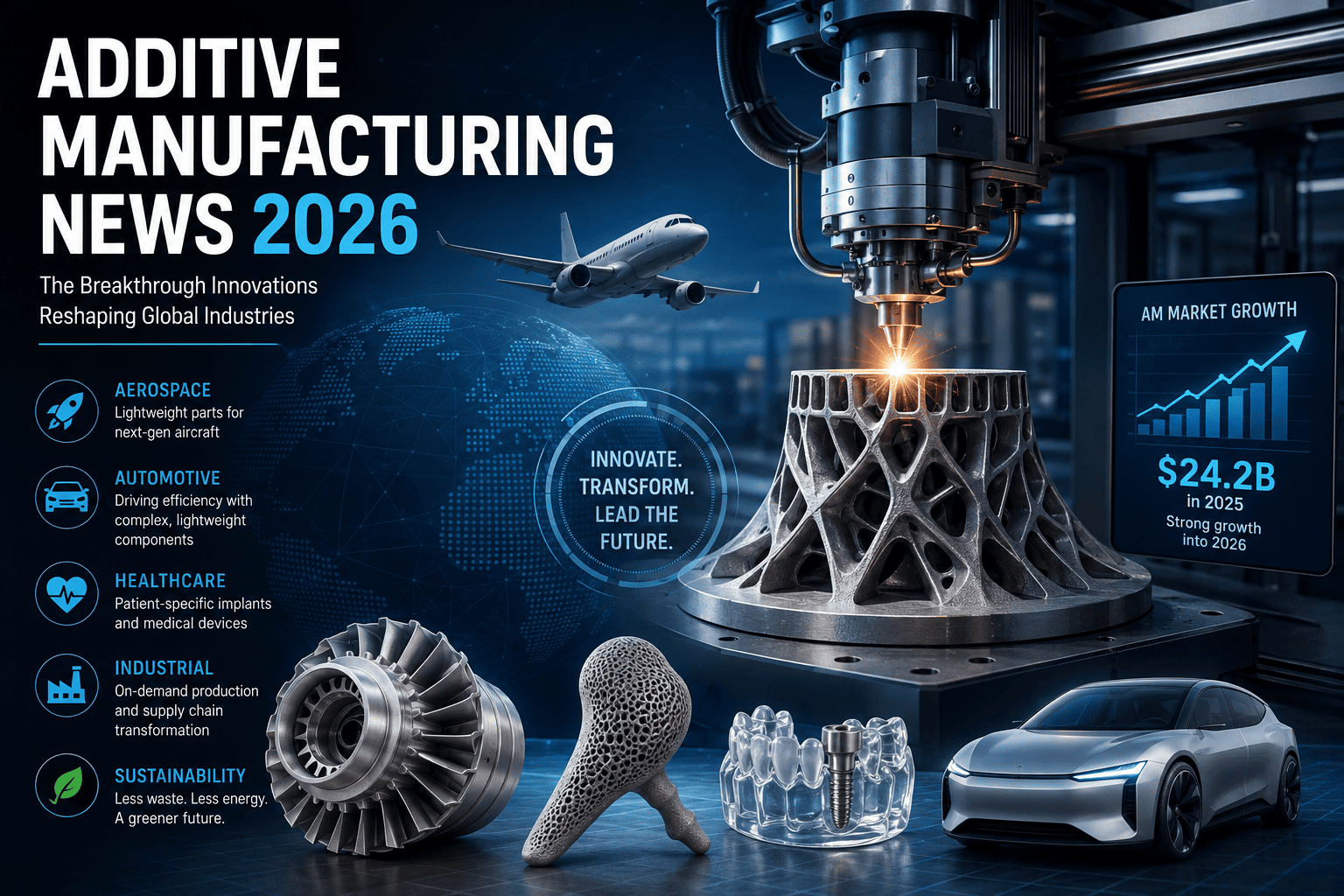
If you follow additive manufacturing news even loosely, you already know 2026 feels different from every year that came before it. The conversation has shifted from “what could 3D printing eventually do” to “how many parts is it printing right now, at what cost, and how reliably.” For manufacturing executives, industrial engineers, aerospace teams, and technology investors, this shift matters because it changes how capital gets allocated, how supply chains get designed, and how factories get staffed. This article breaks down the biggest developments, the sectors driving them, and what they mean for anyone making decisions in advanced manufacturing this year.
Additive Manufacturing (AM) in 2026: From Prototyping Tool to Production Standard
Additive manufacturing (AM) has spent the last two decades earning its reputation as a prototyping and short-run technology. That reputation is now outdated. Industry forecasts point to the global 3D printing market nearly tripling in size, with growth increasingly driven not by novelty projects but by repeatable, end-use production runs in aerospace, automotive, medical, and defense.
What changed? Three things happened at once: printer throughput increased, material science matured, and digital workflows became reliable enough that quality assurance teams stopped treating AM parts as exceptions requiring special sign-off. The result is that Additive manufacturing (AM) is now discussed in boardrooms the same way CNC machining or injection molding is discussed — as a production method with known costs, known tolerances, and known failure modes.
Why This Matters for Decision Makers
For Advanced Manufacturing Decision Makers and Manufacturing Business Owners, this maturity curve is the real story of 2026. The technology isn’t chasing a single flashy breakthrough anymore. It’s being embedded into procurement systems, supply-chain planning software, and factory floor scheduling in ways that make it a default option rather than a special case.
Metal Additive Manufacturing News: The Sector Leading Growth
Nowhere is this maturity more visible than in metal additive manufacturing news. Metal AM is currently outpacing polymer printing in both investment and industrial adoption, with the segment expected to grow at a rate well above the broader AM market. Multi-laser powder bed fusion systems, binder jetting lines, and directed energy deposition cells are being deployed in fleets rather than as single standalone machines.
Several trends are shaping this space right now:
- Defense and aerospace acceleration. Programs supporting Joint Additive Manufacturing initiatives and federal service contracts are pushing metal AM further into mission-critical supply chains, particularly for spare parts and legacy component replacement.
- Alloy diversification. Titanium, Inconel, and specialty aluminum powders are seeing wider adoption as suppliers expand stocking distribution to shorten lead times for manufacturers.
- Scrap-to-part conversion. New processes are emerging that convert scrap metal directly into usable printable feedstock, addressing both cost and sustainability concerns simultaneously.
- Consolidation among suppliers. A smaller number of stronger, better-capitalized metal AM companies is emerging from a period of market correction, which industry analysts view as a sign of a maturing sector rather than a weakening one.
For Industrial Engineers and Mechanical Engineers specifying parts, this means more qualified alloys, more predictable lead times, and a growing library of certified processes to draw from.
Is Additive Manufacturing the Future of Global Manufacturing?
This is the question every Technology Investor and Industry Analyst eventually asks, and the honest answer is nuanced. Is additive manufacturing the future of all manufacturing? No — it is not replacing injection molding, casting, or machining wholesale. But is it becoming a permanent, load-bearing pillar of global production strategy? The evidence increasingly says yes.
Three forces are pushing AM toward permanence rather than novelty:
- Supply chain resilience. Geopolitical disruption and tariff volatility have made distributed, on-demand manufacturing genuinely attractive rather than merely interesting. Producing parts closer to the point of use reduces exposure to shipping delays and cross-border risk.
- Digital thread maturity. Real-time monitoring, remote diagnostics, and closed-loop quality systems mean AM parts can now be tracked and certified with a rigor that used to be unique to traditional aerospace manufacturing.
- Economic viability at scale. Cost per part continues to fall as print speeds and yields improve, pushing AM into applications that were previously too expensive to justify.
None of this means AM wins every job. It means the question executives should ask has changed from “can we trust this technology” to “which parts in our catalog are now cheaper, faster, or better made this way.”
Pros and Cons of Additive Manufacturing in 2026
Any honest assessment of pros and cons of additive manufacturing has to acknowledge that the technology’s strengths and weaknesses have shifted as it has matured.
The Pros
- Design freedom. Complex internal geometries, lattice structures, and consolidated assemblies that are impossible with traditional tooling are now routine.
- Speed to part. Lead times measured in days rather than months for tooling-dependent processes.
- Lower waste. Additive processes use only the material required for the part, versus subtractive methods that remove material from a larger block.
- Localized production. Parts can be printed near the point of need, reducing logistics dependency.
- Material innovation. Multi-material prints and advanced alloys are unlocking part performance that wasn’t previously achievable in a single component.
The Cons
- Upfront capital cost. Industrial-grade metal and polymer systems still carry a significant investment, which remains a barrier for smaller Manufacturing Business Owners.
- Qualification complexity. Regulated industries like aerospace and medical devices require rigorous, sometimes lengthy certification pathways for new materials and processes.
- Skills gap. Demand for materials scientists, process engineers, and AM-specific technicians continues to outpace the available talent pool.
- Post-processing overhead. Depowdering, heat treatment, and surface finishing add time and cost that are easy to underestimate when comparing AM to traditional methods on paper.
Weighing these factors honestly — rather than treating AM as either a silver bullet or a gimmick — is what separates successful adopters from companies that stall out after a pilot project.
Where to Find Additive Manufacturing News Today
Staying current matters more in this industry than in most, because the technology, materials, and regulatory landscape are all moving simultaneously. For anyone tracking additive manufacturing news today, a handful of sources have become essential reading.
Industry professionals increasingly rely on 3d printing additive manufacturing news aggregators and trade publications that cover everything from new machine launches to material supply announcements and contract manufacturing partnerships. Many readers specifically follow Additive Manufacturing magazine, which has built a reputation for deep technical coverage of production-grade applications across aerospace, automotive, and medical sectors. Alongside it, Additive Manufacturing Media has become a go-to daily source for shorter-form updates — covering everything from postprocessing equipment relocations to new powder distribution agreements and defense manufacturing contracts.
For Researchers and Industry 4.0 Enthusiasts, these outlets also serve as an early warning system for shifts in the competitive landscape, since consolidation, new entrants, and technology pivots often show up in trade press well before they appear in quarterly earnings calls.
Choosing the Right Additive Manufacturing Company
Whether you’re a Supply Chain Professional evaluating vendors or a Manufacturing Executive building an in-house capability, selecting the right Additive manufacturing company is one of the highest-stakes decisions in this space. Not all providers are built the same way, and the criteria that matter have shifted as the market has matured.
Key evaluation factors now include:
- Proven production volume, not just prototyping capability — ask for real throughput numbers, not marketing claims.
- Material certification depth, especially for regulated industries like aerospace and medical devices.
- Post-processing and finishing capacity, since this is often the bottleneck that determines real-world lead times.
- Financial stability, given the wave of consolidation reshaping supplier rosters industry-wide.
- Software and digital thread integration, which increasingly determines whether a partner can scale with your production needs.
A strong Additive manufacturing company today looks less like a machine shop with a printer and more like a full production partner offering design consultation, material science expertise, and quality documentation from day one.
The Role of the Additive Manufacturing Association
Standards, advocacy, and workforce development don’t happen by accident, and this is where the Additive Manufacturing Association and similar industry bodies play an outsized role. These organizations bring together manufacturers, material suppliers, machine builders, and end users to establish shared standards for qualification, testing, and safety — work that individual companies simply can’t do alone.
For Industry 4.0 Enthusiasts and Additive Manufacturing Professionals building a career in this space, association membership and events are also one of the fastest ways to build the kind of professional network that leads to job opportunities, partnerships, and early access to emerging best practices. As the technology matures, expect associations to take on a growing role in workforce certification — helping close the skills gap that remains one of the industry’s biggest constraints.
Real-World Additive Manufacturing Examples Reshaping Industries
Abstract discussion only goes so far. The most convincing case for this technology comes from concrete Additive manufacturing examples already in production today:
- Aerospace engines. Manufacturers are combining automation, composites, and multiple AM processes to build next-generation engine components with reduced part counts and weight.
- Dental and medical devices. Multi-material printing now enables devices that combine rigid and flexible sections in a single build, something impossible with earlier single-material systems.
- Large-format construction and tooling. Large-format additive manufacturing (LFAM) systems are producing tooling risers, molds, and even microfactory-scale structures at a fraction of traditional lead times.
- Defense spare parts. Programs converting scrap metal directly into usable defense components are demonstrating both cost savings and supply chain resilience simultaneously.
- Consumer mass customization. Jetted denture platforms and similar high-volume, personalized production lines show how AM is moving well beyond niche or luxury applications.
These aren’t hypothetical use cases. They’re active production lines generating revenue and solving real supply chain problems today — which is exactly why so much attention is now focused on scaling rather than proving feasibility.
Investment and Cost Considerations for 2026
For Technology Investors and Manufacturing Executives weighing where to allocate capital, a few budget realities are worth flagging. Industrial-grade metal systems still require significant upfront investment, but cost per part continues to decline as throughput and yield improve. Companies evaluating AM adoption should model total cost of ownership carefully — including post-processing, software licensing, material sourcing, and workforce training — rather than comparing sticker price against traditional tooling alone. Organizations that treat AM as a long-term capability investment, rather than a one-off project budget line, tend to see stronger returns as the technology continues to mature through 2026 and beyond.
Perspectives Across Roles
Different stakeholders will naturally prioritize different aspects of this shift:
- Aerospace and Automotive Manufacturers are focused on qualification pathways and part certification timelines.
- Medical Device Manufacturers are watching multi-material capability and regulatory clearance processes closely.
- Supply Chain Professionals care most about lead-time reduction and distributed production resilience.
- Industry Analysts and Technology Investors are tracking consolidation, unit economics, and utilization rates as the real signals of market health.
- Additive Manufacturing Professionals on the ground are focused on the growing demand for specialized skills in materials science, process engineering, and quality assurance.
Recognizing which lens applies to your role can help cut through the noise and focus on the developments that actually affect your decisions.
FAQ
What is the biggest additive manufacturing news story of 2026? The dominant theme is the shift from experimental deployment to proven, scaled production — with metal AM, defense applications, and supply chain resilience driving the most significant developments.
Is additive manufacturing the future of manufacturing, or just a niche technology? It’s becoming a permanent, significant piece of the manufacturing landscape rather than a total replacement for traditional methods. Expect it to keep growing alongside — not instead of — conventional production techniques.
What are the main pros and cons of additive manufacturing for a mid-sized manufacturer? The biggest advantages are design freedom, speed, and reduced waste. The biggest drawbacks remain upfront capital cost, qualification complexity, and a persistent skills gap.
Where can I follow additive manufacturing news today reliably? Established trade publications and industry associations remain the most reliable sources, offering daily coverage of new equipment, material announcements, and contract wins.
How do I evaluate an additive manufacturing company before signing a contract? Look beyond marketing claims to real production volume, material certifications, post-processing capacity, and financial stability, since consolidation has made vendor stability a genuine risk factor.
What industries have the strongest additive manufacturing examples right now? Aerospace, defense, and medical devices currently show the most mature, production-scale examples, though large-format construction and consumer mass customization are catching up quickly.
Final Thought
The throughline across every piece of additive manufacturing news this year is maturity. The industry has moved past proving that 3D printing works and is now focused on proving that it works reliably, repeatedly, and profitably at scale. For manufacturing leaders, engineers, investors, and professionals across every sector touched by this technology, the practical task in 2026 isn’t deciding whether to pay attention to additive manufacturing — it’s deciding how deeply to integrate it into strategy, hiring, and capital planning for the years ahead.