It was around 11 PM on a Tuesday, and I was still replying to Instagram comments for my client’s skincare brand while my chai had gone completely cold on the desk. That’s the night I opened Fiverr and typed “digital marketing virtual assistant” into the search bar for the first time, half-desperate, half-skeptical.
I’d heard the term thrown around in a few Facebook groups. People made it sound simple — hire a VA, hand off the boring stuff, get your evenings back. Nobody mentioned the part where you spend three weeks interviewing people who ghost you after the first payment, or the part where you realize you never actually defined what you needed help with in the first place.
So this is that story, minus the fluff. What worked, what didn’t, and the actual steps I’d follow if I were starting over today.
What Does a Digital Marketing Virtual Assistant Actually Do?
Before hiring anyone, I genuinely didn’t know where the line was between a virtual assistant and, say, a full marketing agency. Turns out there’s a big difference, and figuring that out early saves you a lot of money.
A digital marketing virtual assistant is basically someone who handles the repetitive, time-eating marketing tasks remotely — scheduling posts, replying to DMs, doing basic keyword research, building email lists in Mailchimp, formatting blog posts, running simple ad reports. They’re not usually the ones building your entire strategy from scratch (though some senior ones can). Think of them as the person who executes, while you or your strategist decides direction.
My first VA, a woman named Reema working out of Lahore, handled things like:
- Scheduling and posting content on Buffer
- Replying to basic customer comments (with a script I gave her)
- Pulling weekly Google Analytics screenshots into a simple report
- Updating a content calendar in Notion
- Basic Canva graphic tweaks — resizing, swapping text
None of it was glamorous. But it freed up about 9-10 hours a week for me, which is roughly what I was previously losing to admin work I didn’t even enjoy.
The Mistake That Cost Me Three Weeks
Here’s the embarrassing part. My first attempt at trying to hire a digital marketing virtual assistant, I posted a vague job listing that said something like “need help with marketing stuff, flexible hours.” I got 40+ applications and genuinely could not tell any of them apart.
I ended up hiring someone purely because she responded fastest. Big mistake. She was good at graphics but had zero clue how to navigate Meta Ads Manager, which was half the job. We wasted almost three weeks before I admitted it wasn’t working.
Lesson learned — vague job posts attract vague candidates. That single mistake taught me more about hiring than any article did.
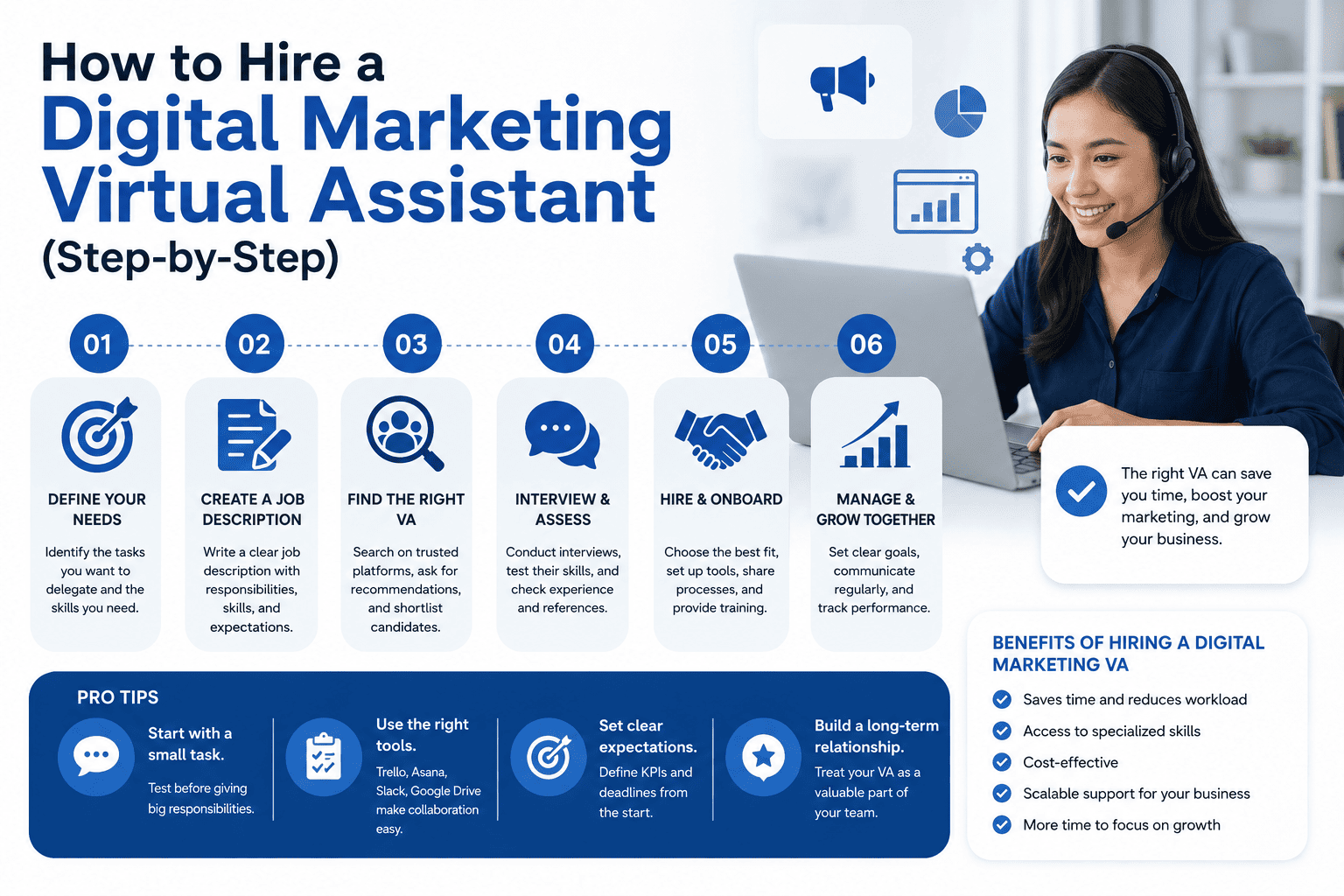
Step-by-Step: How to Hire a Digital Marketing Virtual Assistant Properly
Step 1: List your actual tasks, not your dream job description
Grab a notebook (or Google Doc, whatever) and write down every marketing task eating your time this week. Be specific. Not “social media management” — instead write “posting 3x/week on Instagram, replying to comments before 6 PM, engaging with 15 accounts daily.”
The more specific your list, the easier it becomes to filter candidates later.
Step 2: Decide between freelance platforms, agencies, or dedicated VA companies
This is where digital marketing virtual assistant vs marketing agency comparisons actually matter. An agency usually costs more (think $800-$3000/month) but comes with a full team and strategy built in. A solo VA is cheaper and more hands-on but you’re the one directing the ship.
For small businesses just starting out, a solo VA usually makes more financial sense. I’ve used Upwork, OnlineJobs.ph, and a company called Wishup for different clients — all had different vibes and price points.
Step 3: Set a realistic budget
This is probably the most-asked question I get: how much does a digital marketing virtual assistant cost? Honestly, it varies wildly.
- VAs from the Philippines or Pakistan: roughly $4-$10/hour
- VAs from the US or UK: $20-$45/hour
- Agency-managed VA services (like Wishup or Time etc): $8-$15/hour but often requires monthly retainers, sometimes starting around $999/month
I personally landed somewhere in the middle — paying around $6.50/hour for someone with two years of experience, which felt fair for both sides.
Step 4: Write a job post that filters people automatically
Instead of a generic description, include a small task in the post itself. I started asking applicants to “reply with the word ‘chai’ at the top of your application” just to see who actually reads instructions. Sounds silly, but it cut my applicant pool from 40 to 11 real candidates instantly.
Step 5: Test before you commit
Don’t skip this. Give a small paid test task — maybe two hours of work, like drafting a week’s content calendar or writing three ad captions. Pay for it regardless of outcome; it’s the professional thing to do, and good candidates respect that you’re not asking for free labor.
Step 6: Start with a short trial period
I do two weeks minimum now, sometimes a month. It’s enough time to see if communication style, time zones, and actual output match what you expected on paper.
A Real Example: How This Played Out With My Second Hire
After the Reema situation improved (she actually turned out great once I clarified expectations), I hired a second person for a different client — a small home bakery brand. This time I used the task-list method from Step 1.
The result was noticeably smoother. Within the first week, she’d already set up a proper Trello board, something I hadn’t even asked for but appreciated. That’s usually a good sign — when a remote digital marketing assistant brings small improvements on their own instead of waiting for instructions on everything.
Within six weeks, the bakery’s Instagram engagement had gone from maybe 2% to just over 5%, mostly from consistent posting and faster comment replies — nothing dramatic, just consistency that I didn’t have time for myself.
Common Mistakes People Make When Hiring
Hiring based on price alone. The cheapest option often costs more in redone work and missed deadlines.
Not defining tools upfront. If you use Asana and they’ve only ever used Trello, there’s a learning curve. Small thing, but it adds friction in week one.
Assuming they’ll “figure out” your brand voice. Give examples. Screenshot old posts you liked. Explain what tone to avoid.
No clear communication schedule. Are they updating you daily? Weekly? Over Slack or WhatsApp? I once went four days without hearing from a VA because neither of us set expectations — turned out she thought silence meant everything was fine.
Expecting strategy-level thinking from a task-level hire. Marketing virtual assistant services are usually built for execution, not for building your entire funnel from zero. If you need strategy, that’s a different (and pricier) hire.
Is a Digital Marketing Virtual Assistant Worth It?
For me — yes, mostly. It’s not magic. You still need to manage them, give feedback, and occasionally redo things in the first month. But compared to doing everything solo at midnight with cold chai, it’s a trade I’d make again.
If you’re a small business owner drowning in social media replies and content calendars, a digital marketing virtual assistant for small business needs specifically is probably one of the more affordable ways to buy back your time. Just don’t skip the vetting steps — that’s where most people (including me, the first time) get it wrong.
Start small. One task list, one trial period, one honest conversation about expectations. The rest tends to sort itself out.