Three years ago, a client called me at 11 PM on a Tuesday because their accounting firm got hit with ransomware. Twelve years of client tax records, locked. The attacker wanted $40,000 in Bitcoin. They paid it (don’t ask me how I felt about that), and the files still came back half-corrupted.
That phone call changed how I talk to small business owners about security. Because here’s the thing nobody tells you upfront: most businesses don’t get breached because they had no security at all. They get breached because they had random, disconnected security — a firewall here, an antivirus there, no actual plan tying it together. That’s exactly what a cybersecurity framework is supposed to fix.
So what even is a cybersecurity framework, really?
Strip away the consultant-speak and it’s just this: a structured way to organize your security decisions so you’re not making them up as you go. Think of it like a recipe instead of randomly throwing ingredients in a pot and hoping dinner turns out okay.
I used to think frameworks were just paperwork for compliance audits. Boxes to tick so you could tell a client “yes, we’re secure.” I was wrong, and I learned that the expensive way.
A good IT security framework tells you what to protect, how to protect it, how to detect when something’s gone wrong, and what to do after. It’s not software. You can’t buy a framework off Amazon for $89.99 and install it Tuesday afternoon. It’s a way of thinking, backed by documented processes.
The frameworks you’ll actually run into
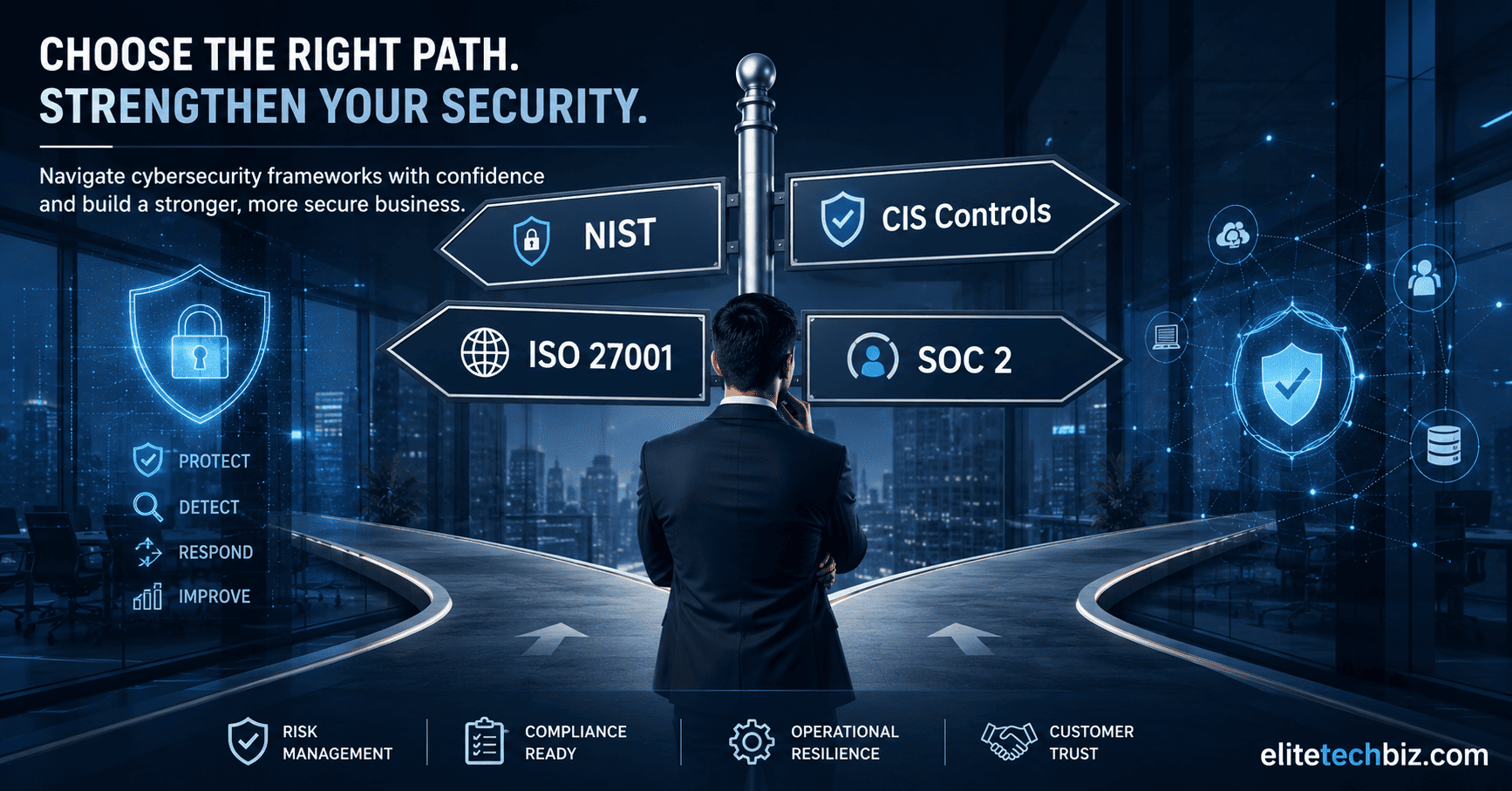
There are dozens of these floating around, but realistically, small and mid-sized businesses bump into maybe four.
NIST Cybersecurity Framework — This one’s American, free, and honestly the friendliest starting point for most businesses. It breaks things into five (now six, since the 2.0 update) functions: Govern, Identify, Protect, Detect, Respond, Recover. I like recommending the NIST cybersecurity framework to clients who feel overwhelmed, because it doesn’t assume you already know what you’re doing.
ISO 27001 framework — More formal, more international, and it comes with actual certification. If you’re trying to land contracts with European clients or anyone in finance/healthcare, they’ll often ask “are you ISO 27001 certified?” point blank. It costs money to get certified though — audits aren’t free, and I’ve seen quotes ranging from $8,000 to $25,000 depending on company size.
CIS Controls — Eighteen controls, very action-oriented, less philosophical than NIST. Good if your team wants a checklist rather than a strategy document.
SOC 2 — Not exactly a framework in the traditional sense, more of an audit standard, but SaaS companies live and die by this one. If you’re selling software to enterprise clients, expect this question in every sales call eventually.
None of these are universally “better.” That’s the part people get wrong when they Google this stuff at 2 AM trying to find the One Correct Answer.
How I actually walk clients through choosing one
Here’s the process I use now, after that ransomware call taught me to stop winging it.
Step 1: Figure out who’s actually asking.
Half the time, a business doesn’t choose a framework out of pure desire to be secure — a client, insurer, or regulator is forcing the issue. Check your contracts first. Some cyber insurance policies (I’ve seen this with Chubb and Travelers policies specifically) now require documented framework adoption before they’ll even quote you.
Step 2: Map out what you’re protecting.
Sounds obvious, but I’ve sat in meetings where nobody could tell me where customer data actually lived. Spreadsheets on a laptop? Salesforce? Some ancient on-prem server in a closet that IT forgot existed? You need this inventory before any framework makes sense.
Step 3: Match complexity to your actual size.
A 12-person marketing agency does not need the same security compliance framework as a 400-person healthcare provider. I’ve watched a small business spend six months and $15,000 on ISO 27001 prep when NIST would’ve covered 90% of their actual risk for free. That money would’ve been better spent on employee training, honestly.
Step 4: Pick a risk management framework angle, not just a checklist.
This is the part people skip. A framework isn’t just “do these 40 things.” It’s supposed to help you decide which risks matter MORE than others, because you can’t fix everything simultaneously with a finite budget.
Step 5: Get someone to audit you against it — even informally.
Self-assessments are fine for year one. But bring in a third party eventually, even if it’s just a $2,000 gap assessment from a local IT security consultant instead of a full certification audit.
A real example: the dental clinic that almost skipped this
One of my clients runs a three-location dental practice. Patient records, insurance billing, the whole HIPAA mess. When we first talked, their “security plan” was a single Windows Server 2012 box (yes, 2012, already past end of support) and a shared password written on a sticky note taped under the front desk monitor. I’m not exaggerating about the sticky note.
We didn’t go full ISO 27001 framework on them — wildly overkill for their size and budget. Instead we built around NIST’s structure, mapped what patient data lived where, fixed the password situation (LastPass for the team, finally), and set up actual backup verification instead of just assuming backups worked.
Eighteen months later, they had an actual incident — a phishing email almost got someone to wire $6,200 to a fake “vendor.” Because we’d built detection and response steps into their plan, the office manager caught it before the money left. That’s the real payoff of these cybersecurity standards — not preventing every single attack, but catching things faster when they happen.
Mistakes I see businesses make constantly
Choosing a framework because it sounds impressive, not because it fits. I’ve had clients insist on ISO 27001 purely because a competitor mentioned it on LinkedIn. That’s not a strategy.
Treating it as a one-time project. You don’t “finish” an information security framework and walk away. Threats change. Your business changes. Review this stuff at least annually, ideally every six months if you’re growing fast.
Buying tools before building the plan. So many businesses drop $30,000 on fancy endpoint detection software before they’ve even figured out what they’re trying to protect. Wrong order. Plan first, spend second.
Ignoring employee behavior. You can have the most beautifully documented risk management framework on paper, and it means nothing if someone clicks a sketchy link in an email titled “Invoice Overdue – URGENT” at 4:45 PM on a Friday when everyone’s mentally checked out.
Forgetting documentation. If your framework lives only in your IT guy’s head, you don’t actually have a framework. You have a guy. And guys quit, get sick, or go on vacation during exactly the week something breaks.
Where I’d start if I were you
Honestly? Start with the NIST cybersecurity framework’s free resources if you’re not already locked into something by a client or regulator. It’s flexible enough to scale up later into ISO 27001 territory if you genuinely need certification down the road. Don’t let perfect be the enemy of started — a half-implemented framework you actually follow beats a perfect one sitting in a binder nobody’s opened since the audit.
The accounting firm from that 11 PM call? They’re on NIST now, with quarterly reviews and an actual incident response plan typed up (not just imagined). Cost them less than the ransom they paid that one bad Tuesday. Funny how that math works out.