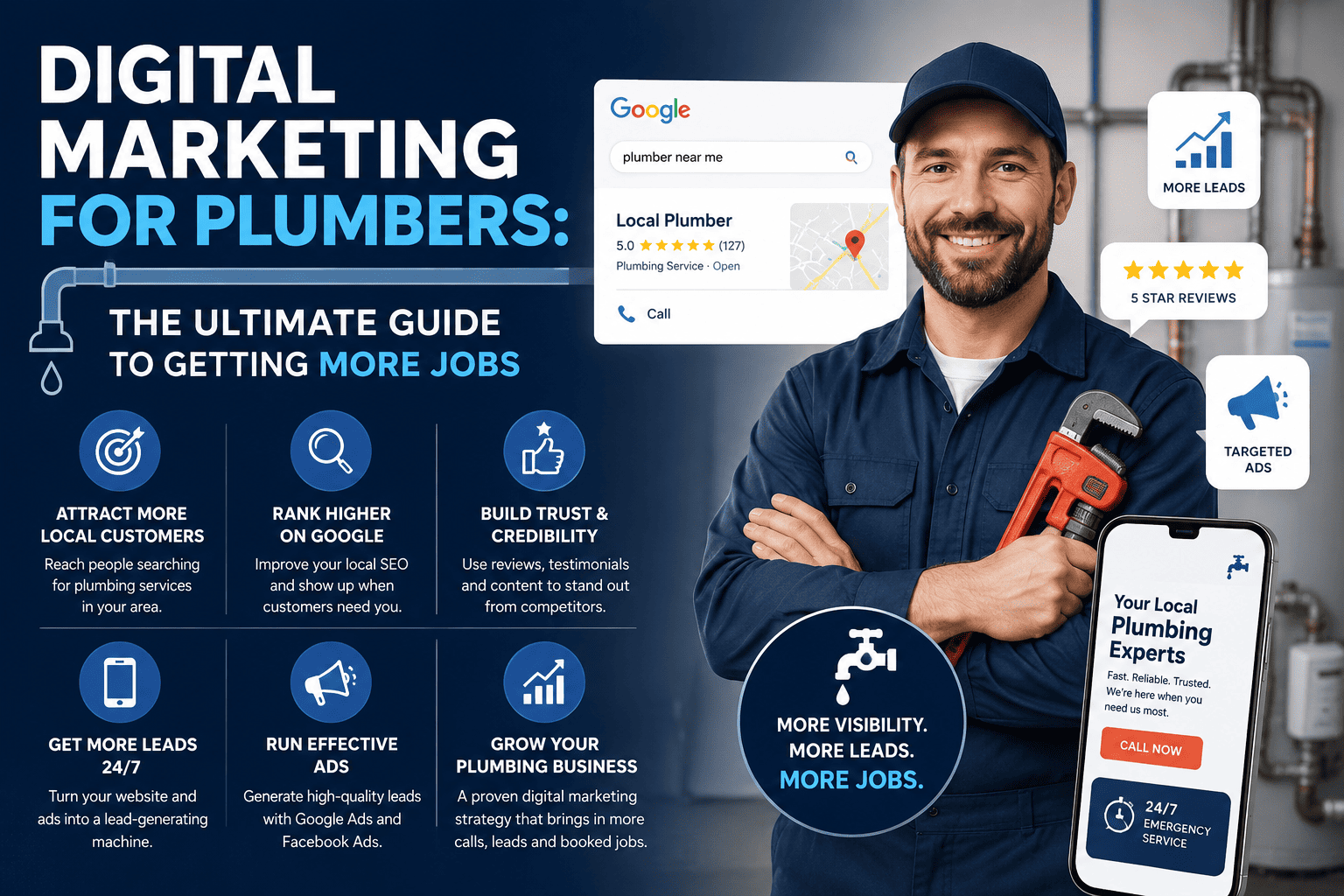
Word of mouth used to be enough to keep a plumbing van busy. That’s no longer true. Today, most homeowners search Google the moment a pipe bursts or a water heater fails, and if your business doesn’t show up, someone else gets the job. Digital marketing for plumbers is how you make sure your business is the one they find, call, and trust.
This guide breaks down exactly what works: local SEO, Google Ads, website design, review management, social media, and how to budget for all of it. You’ll also learn how to tell the difference between a marketing agency that delivers results and one that just sends invoices. By the end, you’ll have a clear, practical plan you can start using this week.
Why Digital Marketing Matters for Plumbing Businesses
Plumbing is almost always a “right now” service. Nobody browses plumbers for fun; they search because something is broken, leaking, or backed up. That urgency changes how marketing needs to work compared to other industries.
When someone searches “plumber near me” or “emergency plumber [city],” they’re usually ready to call within minutes. If your business isn’t visible in that moment — on Google Maps, in search results, or through a well-timed ad — you lose the job to a competitor who is. Plumber advertising isn’t optional anymore; it’s the mechanism that connects your availability with a customer’s emergency.
There’s also a trust factor unique to home services. People are letting a stranger into their house to work on plumbing systems tied to their water supply and property value. A strong online presence — reviews, a professional website, clear service pages — does the reassuring that a handshake used to do.
The Shift From Traditional Advertising to Digital
Truck wraps, yard signs, and phone book ads still have a place, but they can’t be measured or adjusted in real time. Digital marketing vs traditional advertising for plumbers really comes down to control and accountability.
With digital campaigns, you can see exactly how many people saw your ad, clicked it, and called your business. You can pause a campaign that isn’t working within minutes instead of waiting out a print contract. That level of feedback is why most plumbing companies now split their budget toward digital-first strategies, while keeping traditional methods as brand reinforcement rather than the primary lead source.
Local SEO for Plumbers: The Foundation of Everything
Local SEO for plumbers is the process of optimizing your online presence so your business shows up when people in your service area search for plumbing help. It’s the single highest-leverage investment most plumbing companies can make, because it targets people who are already looking for a plumber — not people you’re interrupting.
Google Business Profile Optimization
Your Google Business Profile (formerly Google My Business) is what generates the “map pack” — the three business listings with a map that appear above regular search results for local searches. For a plumber, ranking in that map pack is often worth more than ranking #1 in organic search.
To strengthen your profile:
- Verify your business and keep your name, address, and phone number consistent everywhere online.
- Choose accurate primary and secondary categories (e.g., “Plumber,” “Drainage service,” “Water heater repair service”).
- List every service you offer, from drain cleaning to repiping, with brief descriptions.
- Upload real photos of your team, vehicles, and completed jobs — not stock images.
- Post updates regularly, such as seasonal tips or service announcements.
- Respond to every review, positive or negative, in a professional tone.
On-Page and Technical SEO Basics
Plumbing SEO also depends on how your website itself is built and written. Search engines need to understand what your site is about and confirm it’s trustworthy before ranking it.
Key elements to get right:
- Location-specific service pages. A dedicated page for “Water Heater Repair in [City]” performs better than one generic services page trying to cover everything.
- Fast load times. According to Google’s own research, page load speed directly affects bounce rates on mobile, and slow sites lose visitors before they even see your content.
- Mobile-friendly design. Most plumbing searches happen on phones, often from someone standing next to an active leak.
- Clear calls to action. A visible phone number and “Request Service” button should appear on every page, not buried in a menu.
- Schema markup. This is code that helps search engines understand your business type, service area, and reviews, which can improve how your listing appears in search results.
Building Local Citations and Backlinks
A citation is any online mention of your business name, address, and phone number — think Yelp, Angi, HomeAdvisor, or local chamber of commerce directories. Consistency across these listings is one of the trust signals search engines use to confirm your business is legitimate and accurately located.
Backlinks (other websites linking to yours) still matter too. For plumbers, realistic opportunities include local news features, supplier or manufacturer partner pages, sponsorships of community events, and guest contributions to home-improvement blogs. Quality matters far more than quantity here — a handful of relevant, local links outperforms dozens of irrelevant ones.
Google Ads for Plumbing Companies
Google Ads for plumbing companies puts your business at the very top of search results, above organic listings, for keywords you choose. Unlike SEO, which takes months to build momentum, ads can generate calls the same day your campaign goes live.
How Google Ads Works for Home Service Businesses
You bid on search terms like “emergency plumber” or “sewer line repair near me.” When someone searches that phrase, Google runs an auction factoring in your bid amount and your ad’s relevance and quality. If you win, your ad appears, and you pay only when someone clicks it — this is the pay-per-click (PPC) model.
Google’s Local Services Ads are worth calling out separately. These appear above regular search ads, show a “Google Guaranteed” badge after a background check, and charge per lead rather than per click — often a better fit for plumbers because you’re paying for a phone call, not just a website visit.
Setting Up a Campaign That Doesn’t Waste Money
Poorly managed Google Ads accounts can burn through budget fast. A few practices keep spend efficient:
- Use tightly themed ad groups. Separate campaigns for “drain cleaning,” “water heater repair,” and “emergency plumbing” perform better than one broad campaign.
- Add negative keywords. Exclude terms like “plumber jobs,” “DIY,” or “how to fix” so you’re not paying for clicks from people who aren’t hiring anyone.
- Set a service-area radius. There’s no reason to pay for clicks from outside the neighborhoods you actually serve.
- Track calls, not just clicks. Call tracking software shows which keywords actually generate phone calls, not just website visits.
- Use ad extensions. Sitelinks, callout extensions, and call buttons increase your ad’s visibility and click-through rate at no extra cost.
Plumber SEO vs Google Ads: Which Should You Prioritize?
This is one of the most common questions plumbing business owners ask, and the honest answer is that they solve different problems.
| Factor | SEO | Google Ads |
|---|---|---|
| Time to results | 3–6+ months | Same day to a few days |
| Cost structure | Ongoing investment, no per-click fee | Pay per click or per lead |
| Longevity | Builds lasting equity | Stops the moment you stop paying |
| Best for | Long-term, sustainable lead flow | Immediate jobs, slow seasons, new business launches |
| Trust signal | Organic results feel more credible to many users | Effective but seen as “sponsored” |
Most successful plumbing companies don’t choose one over the other — they run both simultaneously. Ads fill the immediate pipeline while SEO compounds in the background, eventually reducing dependence on paid clicks.
Website Design and Conversion Optimization
Traffic without conversions is wasted marketing spend. A plumber’s website has one job above all others: turning a visitor into a phone call or booked appointment.
Must-Have Elements on a Plumbing Website
- A phone number visible in the header on every page, formatted so mobile users can tap to call.
- Clear service area information, ideally with individual city or neighborhood pages.
- Before-and-after photos or real job photos where possible.
- Licensing, insurance, and certification information displayed prominently — this builds trust fast.
- A simple contact or booking form that asks for only essential information.
- Genuine customer reviews embedded directly on the site, not just linked externally.
Common Mistakes That Cost Plumbers Leads
Slow-loading image galleries, buried contact information, and outdated design all quietly drain leads. So does a lack of individual pages for each core service — a site that only says “we do plumbing” gives search engines and visitors nothing specific to latch onto. Fixing these issues is often cheaper and faster than launching a whole new advertising campaign.
Online Reviews and Reputation Management
Reviews function as modern-day word of mouth, and for home services, they’re one of the strongest factors in a homeowner’s decision. A plumber with 150 reviews at 4.8 stars will consistently out-convert a competitor with 12 reviews at 4.9 stars, simply because volume signals reliability.
How to Get More Reviews Consistently
- Ask at the moment of highest satisfaction — right after the job is completed and the customer has confirmed everything works.
- Send a text or email with a direct link to your Google review page; reducing friction dramatically increases response rates.
- Train technicians to mention reviews briefly, without being pushy.
- Respond to every review within a few days, thanking positive reviewers and addressing negative ones calmly and professionally.
Never offer payment or discounts in exchange for reviews. This violates Google’s review policies and can result in reviews being removed or your profile being penalized.
Social Media Marketing for Plumbers
Social media marketing for plumbers isn’t about going viral — it’s about staying visible to past customers and building local brand recognition. Facebook and Instagram tend to perform best for home service businesses because they reach homeowners directly, while platforms like TikTok can work well for behind-the-scenes or educational short-form content if you have the bandwidth to produce it consistently.
Practical content ideas include:
- Quick tips (how to prevent frozen pipes, signs of a slab leak).
- Before-and-after job photos.
- Seasonal maintenance reminders.
- Team introductions and community involvement posts.
- Customer testimonials shared as short video clips.
Paid social ads can also work well for retargeting — showing ads to people who already visited your website but didn’t call. This keeps your business top of mind without requiring a large ad budget.
How Much Does Digital Marketing Cost for Plumbers?
Costs vary widely depending on market size, competition, and how aggressive your growth goals are. As general industry ranges:
- Local SEO: Typically $750–$3,000 per month for ongoing optimization and content work.
- Google Ads / Local Services Ads: Budgets often start around $1,500–$5,000 per month, with cost-per-click varying heavily by city and competition.
- Website design: A professional, conversion-optimized site typically ranges from $2,500 to $10,000+ depending on complexity.
- Social media management: Usually $500–$2,000 per month if outsourced.
These are general market ranges, not guarantees — actual pricing depends heavily on your location and competitive landscape. A useful rule of thumb: businesses serious about growth often reinvest somewhere between 7–12% of revenue into marketing, adjusting up during growth phases and down once lead flow stabilizes.
Is SEO Worth It for Plumbers?
Yes, for most plumbing businesses planning to operate for more than a year, SEO is worth the investment. It takes longer to show results than paid ads, but it builds an asset — your search rankings and online authority — that keeps generating leads without a per-click cost attached.
The exception is a brand-new business needing jobs immediately. In that case, SEO should still start early since it takes months to mature, but paid ads should carry the lead volume in the meantime. Treating SEO as a long-term utility bill rather than a one-time expense sets realistic expectations.
How Do Plumbers Get More Leads Online?
Consistent lead generation comes from layering several channels rather than relying on one:
- Rank locally through Google Business Profile and on-site SEO.
- Run targeted Google Ads or Local Services Ads for immediate visibility.
- Convert website visitors with fast load times and clear calls to action.
- Build a steady stream of reviews to strengthen trust and rankings.
- Stay visible on social media between service calls.
- Track every lead source so budget shifts toward what’s actually working.
Plumbing marketing agency near me searches often lead business owners toward this same conclusion — the businesses generating the most consistent leads use multiple channels working together, not a single tactic in isolation.
Choosing the Best Marketing Agency for Plumbers
Not every digital marketing agency understands the plumbing industry’s urgency, seasonality, and local nature. Before signing a contract, it helps to ask direct questions.
Questions to Ask Before Hiring
- Do you have experience specifically with plumbing or home service clients?
- Can you show ranking or traffic data from past or current clients (with names redacted if needed)?
- How do you track leads and calls, not just clicks or impressions?
- What’s included in the monthly deliverables, and how often will I get reports?
- Is there a long-term contract, and what happens if I want to cancel?
Red Flags to Avoid
Be cautious of agencies that guarantee a specific ranking position — no legitimate SEO provider can promise a #1 spot, since search engines don’t sell rankings. Vague reporting, reluctance to explain strategy, and pressure to sign multi-year contracts upfront are also warning signs. Digital marketing services for plumbers pricing should be transparent; if an agency won’t break down what you’re paying for, that’s worth questioning before you commit.
Frequently Asked Questions
How long does it take to see results from plumber SEO? Most plumbing businesses start seeing measurable ranking improvements within 3 to 6 months, with stronger results building over 9 to 12 months. Timelines depend on competition in your area and how much content and optimization work is being done.
Can I do digital marketing for my plumbing business myself? Yes, especially basics like claiming your Google Business Profile, asking for reviews, and posting on social media. More technical work like Google Ads management and advanced SEO often benefits from professional help, since mistakes can waste ad budget quickly.
Do I need a website if I already have a strong Google Business Profile? Yes. A website supports your Google Business Profile with more detailed service information, builds trust with visitors, and gives you a place to send paid traffic that a profile alone can’t provide.
How many reviews should a plumbing business aim for? There’s no fixed number, but businesses with 100+ reviews at a strong average rating tend to convert better and appear more trustworthy than those with only a handful. Consistent, ongoing review collection matters more than hitting one target number.
What’s the fastest way to get plumbing leads if business is slow right now? Google Ads or Local Services Ads typically produce the fastest results since they can generate calls within days, while SEO efforts build in the background for longer-term stability.
Should plumbers use Yelp or Angi in addition to Google? They can help, particularly Angi and HomeAdvisor for lead generation and Yelp for additional review visibility, but most plumbing businesses see the highest return from Google Business Profile and Google Ads first, then expand to other platforms as budget allows.
Is print advertising completely obsolete for plumbers? Not obsolete, but less efficient as a primary lead source. Truck wraps, yard signs, and local sponsorships still reinforce brand recognition, especially when paired with digital campaigns that are easier to measure.
Final Thoughts
Growing a plumbing business today depends on being visible at the exact moment someone needs help, and digital marketing for plumbers is what makes that possible. A strong Google Business Profile, a fast and clear website, a steady flow of reviews, and a mix of SEO and paid ads together create a lead pipeline that doesn’t rely on luck or referrals alone.
Start with the fundamentals — an optimized Google profile and a functional, mobile-friendly website — before layering in paid advertising and social media. Marketing that works isn’t about doing everything at once; it’s about doing the right things consistently, tracking what generates actual jobs, and adjusting as your business grows.